|
The
Siamese Standard in history
Below are word for word copies of the
Siamese Show Standard as published in various club, show, and Siamese fanciers
publications.
|
|
The Siamese Standard
- 1903
Published in The Book of the Cat
STANDARD OF POINTS FOR THE "ROYAL" SIAMESE CAT.
Body Colour, - As light and even as possible, cream being most desirable, but fawn also admissible, without streaks, bars, blotches, or any other body markings.
Points, i.e. mask, ears, legs, feet, and tail, dark and clearly defined, of the shade known as "seal" brown.
Mask. - Complete, i.e. connected by tracings with the ears, neither separated by a pale ring (as in kittens) nor blurred and indistinct, the desideratum being to preserve the "marten face," an impression greatly aided by a good mask.
Eyes. - Bright and decided blue.
Coat. - Glossy and close lying.
Shape. - Body rather long, legs proportionately slight.
Head. - Rather long and pointed.
General Appearance. - With points emphasised above, a somewhat curious and striking looking cat, of medium size; if weighty, not showing bulk, as this would detract from the admired "svelte" appearance. In type, in every particular, the reverse of the ideal short-haired domestic cat, and with properly preserved contrasts of colour, a very handsome animal, often distiguished by a kink in the tail.
Remarks. - While admitting that blues, blacks, whites, tabbies, and other coloured cats may be also cats of Siam, these being common to all parts of the world, this club recognises only as Siamese cats those cats the points of which conform to the above standard, and is, in fact, desirous of encouraging the breeding of those particular cats first made known to British fanciers as the "royal" Siamese.
|
The points of the "chocolate" Siamese are the same as above, with the exception of body
colour. |
| VALUE OF POINTS. |
|
| Body Colour |
20 |
| Shape |
10 |
| Coat |
10 |
| Head |
10 |
| Eyes |
20 |
| Mask |
15 |
| Density of Points |
15 |
| _________________________ |
| Total |
100 |
|
|
Any cat failing to obtain 75 of the above marks shall not be eligible for the club's challenge prizes and medals.
|
|
Siamese Show Standard -1910 |
|
Published in Cats and All About Them
1910 by L.H. Fairchild, M.D. and Helen Fairchild |
| Siamese
Even the most indifferent observer can tell at a glance that the Siamese is a breed entirely separate
from other cats, both because of his appearance and his unusual vocal talents. The owner of one can (and will) talk for hours on the intelligence and unique characteristics of this beautiful short-haired cat.
The Siamese is a semi-albino which accounts for its peculiar coloration. There are two color classes for the show type Siamese, the Seal Point and the Blue Point. In the Seal Point the coat is cream or fawn color and the "points" (mask, ears, legs and tail) are a seal brown shade. The eyes are deep blue. The Blue Point has a light blue (or sometimes almost a cream) coat, darker blue points and blue eyes. The
semi-albinism also accounts for the fact that the kittens are born pure white with points pink.
These are medium sized, dainty cats with clean-cut limbs, the hind legs being longer than the front and giving them the appearance of "walking down hill." They have a long, wedge-shaped head with good width between the ears, and a flat forehead. The ears are large and open wide at the base. The eyes are almond in shape and set at a typical oriental slant. The tail should be long and
whip like, tapering to a point at the end. Although the show standard allows a slight kink at or near the end of the tail, everything else being equal a perfectly straight tailed cat will win over one with a kink. The coat should be sleek, hair short and lying close to the body.
Siamese are great climbers and jumpers and this
together with their mischievous nature, their intelligence and monkey-like appearance has given rise to the oft-repeated legend that the Siamese had a monkey or two in its oriental ancestry. This, of course, is
absurd.
They are very affectionate, especially to their
owners, and are very fine hunters. The kittens are natural retrievers and can soon be taught to bring back a stick or piece of wadded paper which they will gaily do until the trainer is completely worn out with tossing
it again and again. They are easily trained to go on a leash and to ride in a car. The kittens are quite homely until they reach the age of about three and one-half months when they lose their rough, longish kitten hair and get a lovely sleek short coat.
The only complaint that can be made against the Siamese as the perfect house pet is its loud voice. Even its most ardent admirer must admit that a
Siamese loves to talk and talk loud. Fanciers find this throaty jungle cry fascinating, but unfortunately the next door neighbor does not always concur in this opinion. Siamese owners always say and sincerely mean, "If you once have owned a cat of this breed you will never be happy without one."
|
| BODY COLOR — Even pale, fawn or cream shading gradually into cream on belly and chest. Kittens paler in color. In judging body color, allowance should be made for older cats, since the body color of the Siamese darkens as the cat
grows older. |
15 points |
| POINTS — Mask, ears, legs and tail clearly defined and deep seal brown. Mask complete and, excepting kittens, connected
by tracings with the ears. |
15 points |
| SHAPE — Medium in size, body long and svelte, legs proportionately slim, hind legs slightly higher than front legs, feet
small and oval. |
15 points |
| EYES — Clear, bright and deep blue in color, oriental in shape and slanting towards
the nose. No tendency to squint. |
15 points |
| HEAD—Head long and well proportioned with width between the eyes, narrowing in straight lines to a fine muzzle, giving the impression of a marten face. Ears, rather large and pricked, wide at
base. |
15 points |
|
CONDITION
— Not fat. Inclined to muscle.
COAT
— Very short and fine in texture, glossy and close lying. |
15 points |
| TAIL—Long, tapering, straight, slightly kinked at or near extremity allowed. Winners to be withheld from cats with
bobbed, screwed or pom pom tails. |
15 points |
| Objections: Pale eye color; odd eyes; grey or
yellowish tinge in the eyes; blotchy or mixed coat-, tabby or ticked markings or shading; white toes, light hairs appearing in the seal brown points; disqualify for extra
deformities or scars; any attempt to deceive the judge or "doctor" the coat.
Judges should note any tendency towards undershot jaw, giving a false appearance of the desired wedge shaped head.
Blue Point Siamese: The above standard to apply to Blue Point, except that the coat is to be pale cream with a "bluey" tinge and the points to be deep blue.
|
|
|
|
The
Siamese Standard - 1930
United Cat Clubs of America, Inc.
BODY COLOR: Pure cream or light fawn, without bars, blotches or markings.
POINTS: Mask, ears, legs, feet and tail, pure seal brown.
MASK: Complete seal brown, connected by brown tracings with the ears. Not
to be separated by a pale ring (as in Kittens) nor blurred or indistinct, the ideal
being to preserve the "Marten face."
EYES: Bright, clear blue, somewhat slanting toward the nose.
COAT: Soft, sleek, short, glossy and close lying.
SHAPE: Body rather long and svelte, with legs proportionately slim, feet small
and oval.
TAIL: Long and tapering, slight kink permissible.
HEAD: Long and wedge-shaped, ears to be rather large and pricked.
CONDITION: Not too fat, inclined more to muscle.
Note: Siamese Cats with brown or white spots on stomach or throat,
gray or greenish tinge in eyes, odd eyes. blotched colored coats, tabby or tickled markings, extra or white toes, or long hairs appearing in the brown points are seriously handicapped from winning awards.
SCALE OF POINTS
Applicable to all breeds.
Color ....................................................................25
Coat and condition................................................ 25
Head, including size and shape of eyes....................20
Body type..............................................................20
Eye color...............................................................10
______
Total......................................................................100
|
|
The
Siamese Standard - 1936
by
Virginia Cobb
Here is what the perfect
Siamese cat would look like according to the standard of the Siamese Cat Society
of America. This Standard, approved by the Cat Fanciers’ Association, is the
basis for judging Siamese cats in the Siamese Specialty show and in all C.F.A.
all-breed shows.
BODY COLOR - Even, pale, fawn, or cream shading gradually
into cream on the belly and chest. Kittens paler in color. 15
points
POINTS – Mask, ears, legs and tail clearly defined and deep
seal brown. Mask complete and (excepting kittens) connected by tracings with the
ears. 15 points
SHAPE – Medium in size, body long and svelte, legs
proportionately slim, hind legs slightly higher then front legs, feet small and
oval. 15 points
EYES – Clear, bright and deep blue in color, oriental in
shape and slanting towards the nose. No tendency to squint.
15 points
HEAD – Long and well proportioned with width between the
eyes, narrowing in straight lines to a fine muzzle, giving the impression of a
martin face. Ears, rather large and pricked, wide at base.
15 points
CONDITION – Not fat,
inclined to muscle. 10
points
COAT
– Very short and fine in texture, glossy and close lying.
10 points
OBJECTIONS – Pale eye
color; odd eyes; gray or yellowish tinge in the eyes; blotchy or mixed coats;
tabby or ticked markings or shading; white toes; light hairs appearing in
the seal brown points; disqualify for extra deformities or scars.
Blue Point Siamese – The
value of points and standard of points for the Blue Point Siamese is the same as
for the Seal Point Siamese with the exception of body color, which should read,
“Pale even blue or cream color” and Points should read, “Dark blue instead
of seal brown.”
Championship classes are
now granted for Chocolate Siamese, the same value of points to apply, the
standard of points to be changed as follows:
SHAPE – Larger in size
then the Seal Point Siamese.
HEAD – Not so wedged
shaped as the Seal Point Siamese.
BODY COLOR – Chocolate, shaded on neck and abdomen.
COAT – Coarser then that of a Seal Point, approximating somewhat
to the domestic short hair.
The same objections would
apply in both the Chocolate and the Blue Point Siamese.
|
|
January
1938 - BY MRS. VIRGINIA R. COBB - Secretary, Siamese Cat Society of America
So many people have written asking questions about the revised standard of the Siamese Cat
Society of America in regard to tails that this seems a good opportunity to go into details. There is really little change in the standard from the one that has been used for years. The members felt that too little was allowed in the scoring for tails. Therefore this was changed from five points to ten. This permits the judge to allow 10 points for the perfect tail, that is, a long, straight tapering tail (slight kink in end permitted), or to grade, according to the types of tails encountered, that might be long, but have
varying kinks through them; thick instead of tapering, etc.
As this long tapering tail is the type chosen by vote it was decided to withhold "winners" from those cats having a bobbed, screwed up or just a porn porn of hair. It was felt that a cat that is long and
slender like the Siamese is naturally "finished" by the same type of tail. To say just the exact length that is meant by "bobbed" is difficult. Naturally a tail that is only one, two or three inches long is NOT a long tail. The writer feels that any cat having a tail four inches or under would come under the
classification of "bobbed", and such a tail has in all I have seen had a thick blunt end.
|
|
STANDARD FOR SIAMESE
Issued by the Cat Fanciers' Association, Inc. — August, 1944
Seal Point
Scale
BODY COLOR__________ 15
Even pale fawn or cream, shading gradually into a lighter color on belly and chest.
Slightly Kittens lighter in color.
darker allowed for older cats.
POINTS________________ 15
Mask, ears, legs, feet and tail, dense and clearly defined, deep seal brown.
Mask complete and, except in kittens, connected by tracings with the ears.
SHAPE (Body and Tail)_____ 20
The body should be medium in size, long and svelte.
Neck long and slender, legs proportionately slim, hind legs slightly higher than front, feet small and oval.
Tail long and tapering. A slight kink at or near the end is allowed.
HEAD AND EARS________ 15
Head long and well proportioned with width between the eyes, narrowing in straight lines to a fine muzzle, giving the
impression of a marten face.
Allowance to be made for jowls in the Stud cat.
Ears rather large and pricked, wide at base.
EYES (Color, 10; Shape, 10)_ 20
Eyes clear and of a deep blue color. Oriental in shape and slanting towards the nose.
COAT__________________ 10
Short, fine in texture, glossy and lying close to body.
CONDITION _____________5
Good physical condition. Not fat, inclined to muscle.
Blue Point
The above standard to apply to the Blue Point Siamese except the coat is to be a bluish white.
Points to be a deep gray blue.
UNDESIRABLE
Round heads; round eyes; cross-eyes; rough or shaggy coats; tabby or ticked markings; light hairs appearing in points; dark spots on belly; receding chin.
|
|
FANCY
CATS A Guide To Their
Standard - 1964
by
Irene Powell - Chatami Cattery
SIAMESE
Siamese, prolific, gregarious little creatures, are the clowns of the cat species and the most numerous and popular of the pedigreed cats. Volumes have been written on this breed, and a great deal must be learned if one is to be a judge. Of necessity, the information here is condensed, but the most pertinent aspects are discussed.
If a square box represents the Persian, then the oval tube
represents the Siamese. The body is long and slim. The abdominal muscles must be taut and firm so that there is no belly sag. There should be
even a suggestion a ''tuck-up''. The shoulders and chest are narrow, but not shallow. The neck is long, slender, and graceful, and clearly separates the
head from the body. The hips, too, are slim. The legs are long, slender, and shapely. They must not look like sticks. The hind legs are longer
than the front so that there is an incline from the rump to the shoulders. The feet are oval and dainty. In keeping with the body lines, the tail is long, slender at the base, and tapers to a fine point. The tail must be straight. A slight kink or irregularity is allowable, if it is not visible and is in the last several vertebrae only.
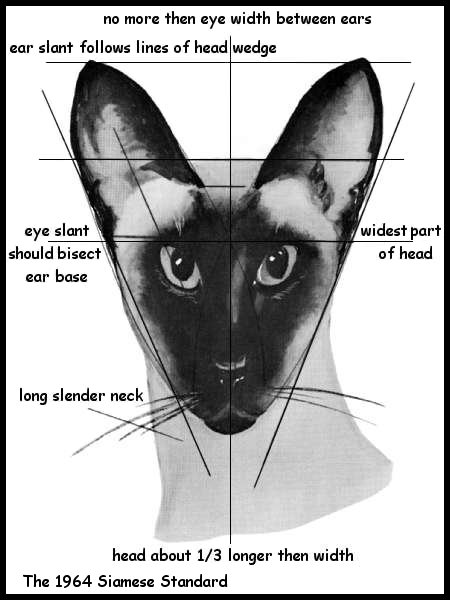
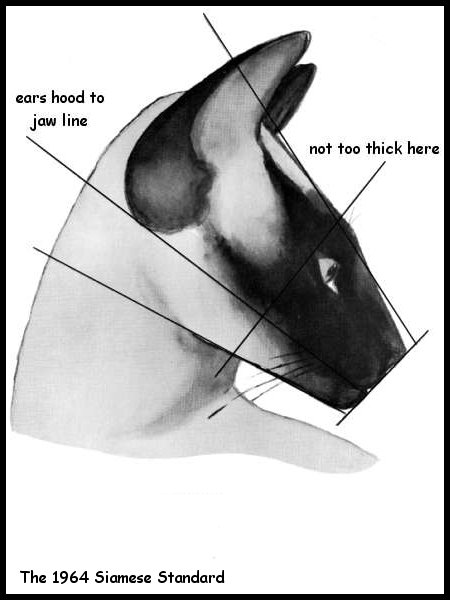
The head should be long and as near to a true wedge with flat planes as possible. Although the wedge must be fairly narrow, there must be enough room for brains and width between the eyes. The greatest width should be above the eyes at the base of the ears. The wedge then narrows
down with out a pinch, either under the eyes or at the whiskers, to a fine, pointed muzzle. The forehead is flat. Viewed from the side, the head presents a straight line from just above the eyes to the tip of the nose. The jaws should be in a straight line, neither over or undershot. The back of the skull should show behind the ears, but the occiput (the hind-most point of the skull) should not protrude so much that it creates a hammerhead.
The eyes should have an oriental appearance, that is, they should be oval with both corners pointed. The inner corners should slant
toward the nose so that, as nearly as possible, lines drawn from the outer corners of the eyes
would bisect the ear openings. A length of an eye between the eyes is ideal. For eye color a deep shade of sapphire blue is desirable, but the color in the dilutes may be a little paler. The eyes should be brilliant as though a light were shining behind them.
The ears should be large, open, pricked forward, and somewhat pointed, and they should flare enough to continue the line of the wedge. There should be no more than the length of an eye between the ears.
The Siamese coat lies very close; it must be short, sleek, and glossy.
Although the hairs are fine, a good coat feels hard. A rough, harsh coat is very undesirable.
The over-all picture of this breed is of a medium to small, svelt cat which is dainty in structure and shows capabilities of great activity.
There are five recognized colors.
First, the Seal with sable (blackish) brown points. The body color
is fawn, a warm shade without hint of greyness. There may be darker shading about the shoulders and rump - older cats may darken considerably
all over, but there must be good contrast between point and body color at all times. The chest and under sides will be much paler than the back. The points on all colors should be well developed and sharply defined. The chin must be dark also, but the shading must not run down the throat. There must be delicate tracings of mask color to the ears, but there must be no sign of a complete hood. Nose and pad leather must be the same color as the points. Seal Point kittens are paler, but they should be creamy rather than white.
Second, the Chocolate which is the dilute of the seal. The body shading on the dilutes is not appreciable. The Chocolate should be ivory all over with no sign of dinginess. Points should be a warm cinnamon milk-chocolate. The mask must be developed enough so that the cat doesn't look like Rudolph, the red-nosed reindeer. All points should show the same density. Nose leather is burnt-rose; pads are cinnamon pink.
Third, the Blue Points. Because the Blue Points have been crossed with the Seals, the body color too often is not the cool bluish-platinum the standard specifies. The color maybe too warm
in tone. The undersides and chest should be an icy or oyster white. The points should be a rich,
grey-blue, and no one point should be more intense than another. The tail must be free from "rings". Nose and pad leather is a deep
smokey-blue.
Fourth, the Frost, or Lilac, which is the dilute of the Blue Points. Body color is very pale-milk-white without shading. The points are a pale silvery-blue
with warmth from the pink flesh tones which show through. The tail must not show "rings", and it must have the same tone as the mask, ears, and legs. Nose leather has a translucent, old lilac hue; the foot pads are coral-pink.
[note:
today 2007 we know blue is the dilute of seal and lilac is the dilute of chocolate]
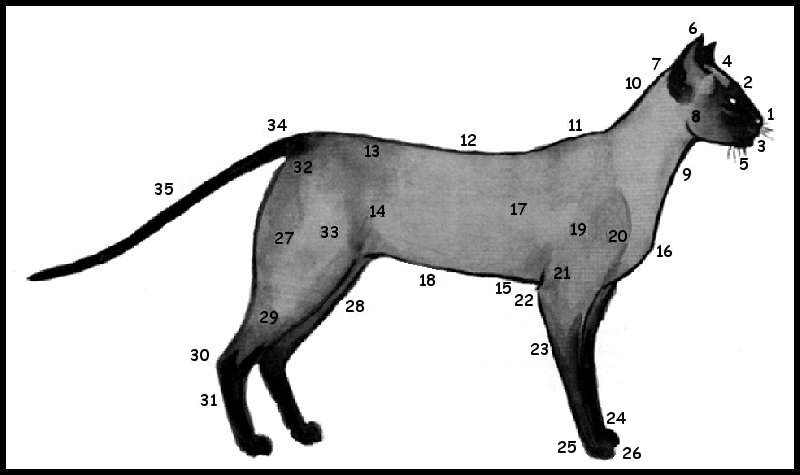
HEAD:
1. Nose and nostrils, 2. Stop of nose, 3. Lips and chin, 4. Forehead, 5. Seta (whiskers), 6. Ears, 7.
Occiput, 8. Cheeks, Teeth - 30 (12 incisors, 4 canines, 14 molars),
NECK: 9. Throat, 10. Nape or crest, TRUNK: 11. Withers, 12. Back, 13. Loins, 14. Flank, 15. Chest, 16. Chest Front, 17. Rib Cage, 18. Belly,
FORELEGS: 19. Shoulder, 20. Point of shoulder, 21. Upper arm, 22. Elbow, 23. Forearm, 24. Ankle or
carpus, 25. Metacarpus, 26. Paws,
HINDLEGS: 27. Upper thigh, 28. Knee joint or stifle, 29. Lower thigh, 30. Heel, 31. Hock,
HINDQUARTERS: 32. Croups or rump, 33. Hip, 34. Root of tail, 35. Tail (The caudal vertebrae vary greatly in number according to the length of the tail. The last few vertebrae are about the size of a match stick. )
DIRECTORY OF CAT REGISTRY ASSOCIATIONS
(to which this standard applies)
AMERICAN CAT ASSOCIATION, Inc.
AMERICAN CAT FANCIERS ASSOCIATION, Inc.
CANADIAN CAT ASSOCIATION
CAT FANCIERS ASSOCIATION, Inc.
CAT FANCIERS FEDERATION, Inc.
NATIONAL CAT FANCIERS ASSOCIATION, Inc.
UNITED CAT FEDERATION, Inc.
|
|
Purina's
Cat Show Guide - Circa
mid 1960's
This
guide was with other items from 1964 and contains the Rex Cat.
Rex
was accepted for championship status in CFA in 1964.
SIAMESE
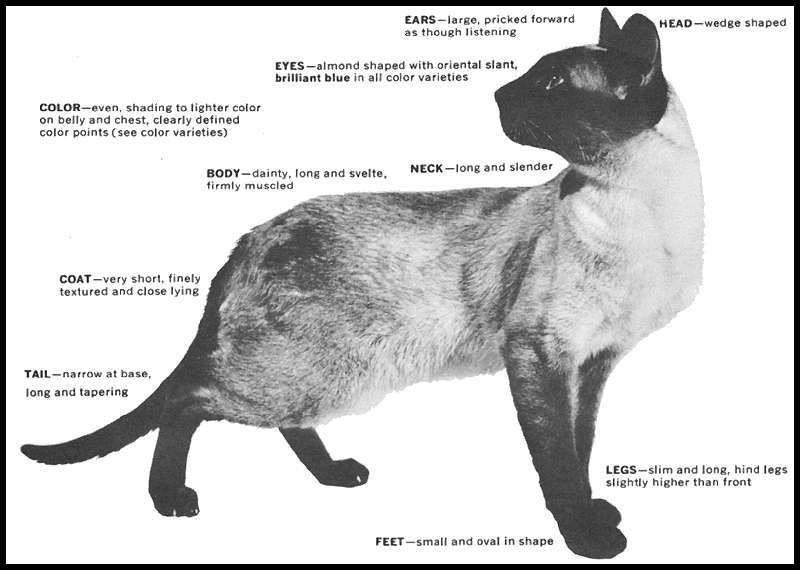
SIAMESE
The best known of the foreign short hair cats. This breed has a distinct
personality, like that of a rowdy little boy who gets into everything. Tend to
be great, loud talkers.
SIAMESE COLOR VARIETIES INCLUDE:
SEAL POINT: fawn
or cream body—with dense, deep seal-brown points. Nose leather & paw pads
same color as points.
BLUE POINT:
platinum grey body of bluish tone—with deeper greyish-blue points. Nose
leather & paw pads to be slate colored. CHOCOLATE POINT: ivory body all
over—with warm, milk chocolate points. Nose leather & paw pads to be
cinnamon pink. FROST OR LILAC POINT: milk white body—with frost-grey points of
pinkish tone. Nose leather & paw pads to be mauve.
Major faults which
cost this breed judging points are: kinked tail; rounded head; thickly-set body;
oddly colored or crossed eyes; improper coloring.
|
|